
Second Circuit Upholds Injunction Blocking New York From Regulating Abortion Pill Reversal Speech
Judges rule that anti-abortion centers’ “abortion pill reversal” statements qualify as protected, noncommercial speech.

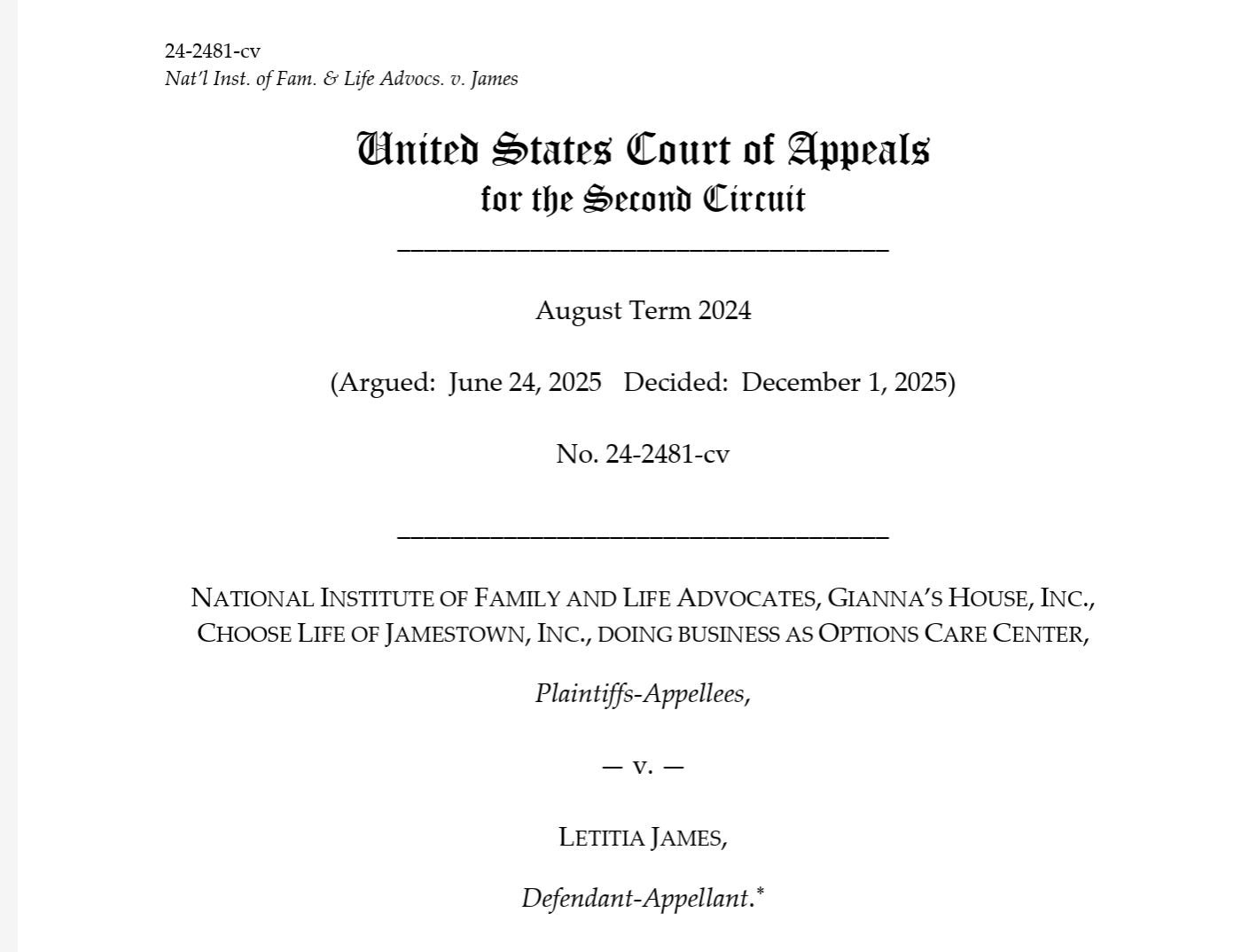
The U.S. Court of Appeals for the Second Circuit has upheld a preliminary injunction preventing New York Attorney General Letitia James from enforcing state consumer-protection laws against several crisis pregnancy centers over their promotion of “abortion pill reversal” (APR). In a unanimous decision, the court ruled that the centers’ APR-related statements qualify as noncommercial speech protected by the First Amendment and that New York had not justified restricting that speech.

The case arose after New York filed a civil enforcement action against Heartbeat International and several affiliated organizations, alleging that they misled patients about APR—an unproven protocol promoted by anti-abortion groups as a way to continue a pregnancy after taking mifepristone, the first drug in a medication abortion. Following that enforcement action, other pregnancy centers, including NIFLA, Gianna’s House, and Options Care Center, removed similar APR language from their websites and materials. They said they feared the state would target them next and argued that the threat of enforcement chilled their ability to speak.
A federal district court granted those centers a preliminary injunction in August 2024. The Attorney General appealed, arguing that the federal courts should step aside because the state was already litigating similar issues against other organizations. The Second Circuit rejected that argument, holding that the plaintiffs were not parties to the state case and that their lawsuit concerned their own speech. The court emphasized that they had previously made statements similar to those at issue in the state enforcement action and had stopped only because they feared prosecution. That, the judges said, placed them firmly within the category of plaintiffs who may seek federal protection of their First Amendment rights even when related state proceedings are underway.
The core of the ruling focused on whether the pregnancy centers’ APR messaging constituted commercial speech. If it did, the state would have more authority to regulate it as potentially misleading. But the court concluded that the speech was noncommercial. It noted that the organizations do not provide APR themselves, charge no fees, receive no financial benefit from referrals, and base their messaging on religious and moral beliefs rather than economic motives. Because their statements do not propose a commercial transaction, the court held, they fall outside the boundaries of commercial speech.
Classifying the speech as noncommercial meant the state would have to survive strict scrutiny—the highest constitutional standard—to regulate it. The Attorney General did not attempt to argue that the state’s actions could meet that bar. Without such a showing, the court held, New York could not restrict the centers’ statements at this stage of the case.
The panel also agreed that the plaintiffs had shown irreparable harm, noting that even temporary loss of First Amendment rights qualifies as such. It concluded that protecting constitutional speech rights is in the public interest and therefore upheld the injunction.
The ruling does not decide the ultimate constitutionality of New York’s efforts to police APR claims. Still, it bars the Attorney General from taking action against these specific organizations while the case proceeds. Meanwhile, the state’s enforcement action against Heartbeat International and its affiliates continues separately.