
When Evidence Meets Ideology: Inside the Senate’s Latest Abortion Hearing
As state officials, physicians, and federal regulators clash over abortion pills, a Senate hearing reveals how ideology—not evidence—is driving the next phase of the post-Dobbs era.

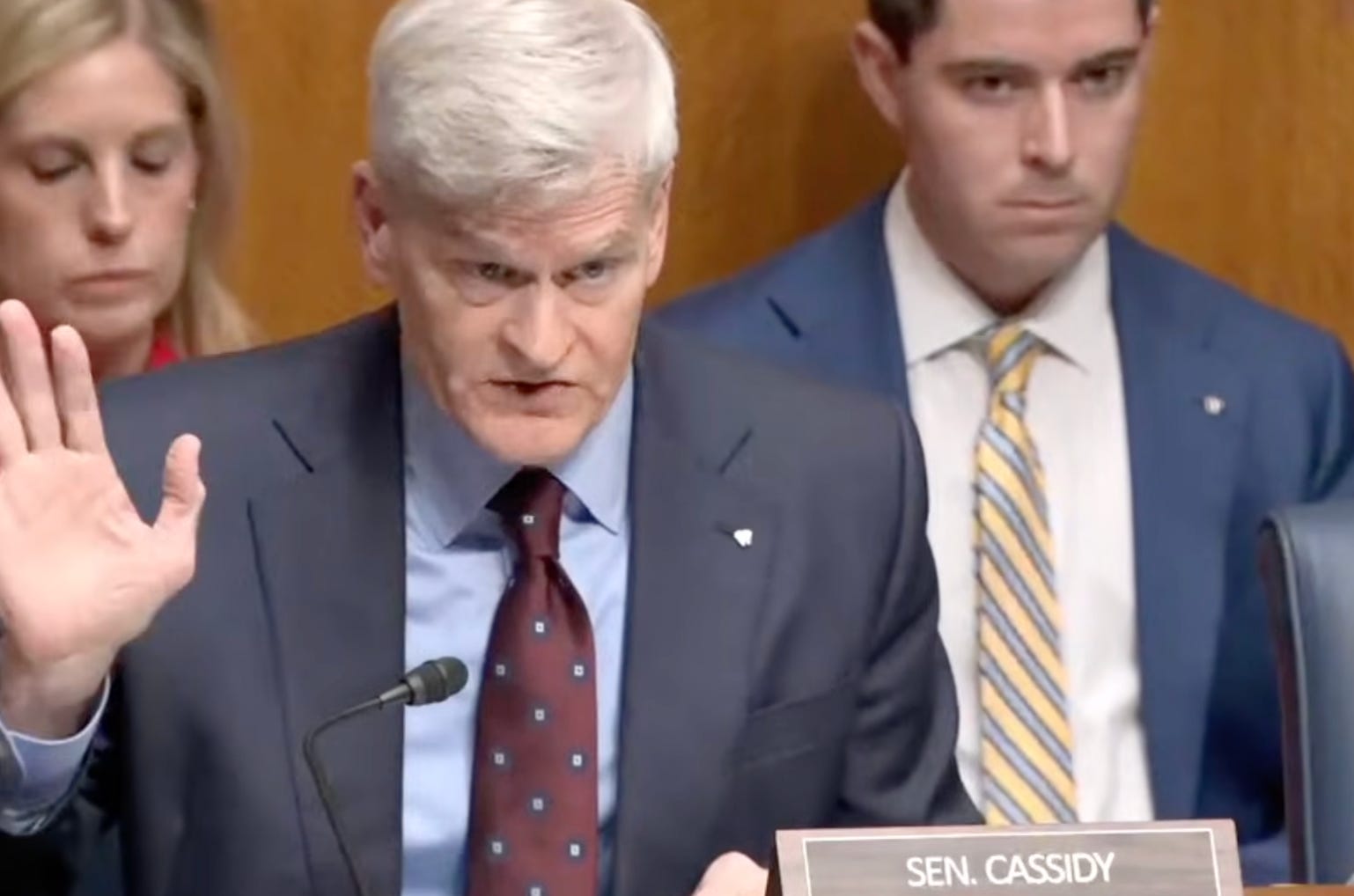
On Wednesday, three witnesses sat before the Senate Health, Education, Labor & Pensions Committee and described three fundamentally different versions of the same country. Each spoke with confidence. Each insisted the facts were on their side. And each revealed, in their own way, how far the abortion debate has drifted from a shared understanding of medicine, law, and lived experience.
The hearing—styled as an inquiry into the “dangers of chemical abortion drugs”—was less a fact-finding exercise than a portrait of a nation arguing with itself about what counts as evidence, whose suffering matters, and whether federal health policy should be governed by medical consensus or political grievance.

At the center of the conflict was Mifepristone, a medication approved by the FDA more than two decades ago and used safely by millions. Around it swirled a familiar post-Dobbs tension: states asserting control, federal agencies defending national standards, and patients caught in between.
Louisiana Attorney General Liz Murrill framed her testimony as a story of regulatory betrayal. In her telling, the FDA’s decision to allow mifepristone to be dispensed by mail after the fall of Roe v. Wade was not merely a policy shift but an intentional effort to nullify state abortion bans. She described a shadow network of out-of-state doctors, shield laws, and mailed pills, portraying federal regulators as complicit in what she characterized as widespread lawlessness and danger
Her testimony relied heavily on anecdotal accounts, criminal prosecutions, and selective data, all arranged to suggest a public health crisis driven not by a lack of access to care, but by too much of it. The through-line was clear: abortion pills, especially when provided through telehealth, are inherently unsafe, insufficiently regulated, and incompatible with state authority.
But when the hearing shifted from prosecutors to physicians, the frame changed.
Dr. Monique Chireau Wubbenhorst presented herself as a clinician sounding an alarm, but her testimony read more like an indictment of abortion itself than an assessment of medication safety. She asserted that abortion—chemical or surgical—constitutes “intentional feticide,” and repeatedly linked abortion care to coercion, trafficking, long-term mental illness, and even eugenics. Her presentation marshaled an enormous volume of studies, many disputed, some retracted, and others drawn from advocacy-aligned sources, to argue that abortion is uniquely dangerous among medical procedures
Notably absent from this testimony was proportionality. Risks associated with pregnancy, childbirth, and forced continuation of pregnancy—especially in a country with rising maternal mortality—were largely ignored. So too was the medical consensus: that complication rates for medication abortion are low, that serious adverse events are rare, and that telehealth provision has been studied extensively.
That consensus entered the room when Dr. Nisha Verma took the microphone.
Verma, an OB-GYN who provides abortion, miscarriage, and full-spectrum reproductive care, did something strikingly rare in congressional hearings: she spoke plainly about evidence. She reminded the committee that mifepristone has been the subject of hundreds of peer-reviewed studies, that serious complications occur in well under one percent of cases, and that telehealth medication abortion has outcomes comparable to—or better than—many forms of in-person care
She also reframed the question entirely. The real danger to patients, Verma argued, is not access to abortion pills but the erosion of access to health care itself: clinic closures driven by funding cuts, Medicaid restrictions, maternity-care deserts, and the chilling effect of criminalization on both patients and providers. In this landscape, telehealth is not a loophole—it is a lifeline.
What emerged from the hearing was not a dispute over data so much as one over authority. One side believes federal science cannot be trusted if it conflicts with state ideology. Another believes medicine must be governed by moral absolutes rather than outcomes. And the third insists—quietly but firmly—that health policy should be guided by evidence, not fear.
For those watching closely, the hearing offered a familiar lesson. When abortion opponents say they are “protecting women,” what they often mean is protecting a political narrative—one that treats women’s autonomy as suspect, their doctors as criminals, and their lived experiences as secondary to an abstract moral project.
The danger is not Mifepristone. The danger is what happens when science is put on trial and ideology is allowed to render a verdict.